Reading a Cricket Ground from the Boundary
Reading a cricket ground from the boundary helps you follow the pitch, fielders and batter movement, making changes in direction and field placement easier to track.
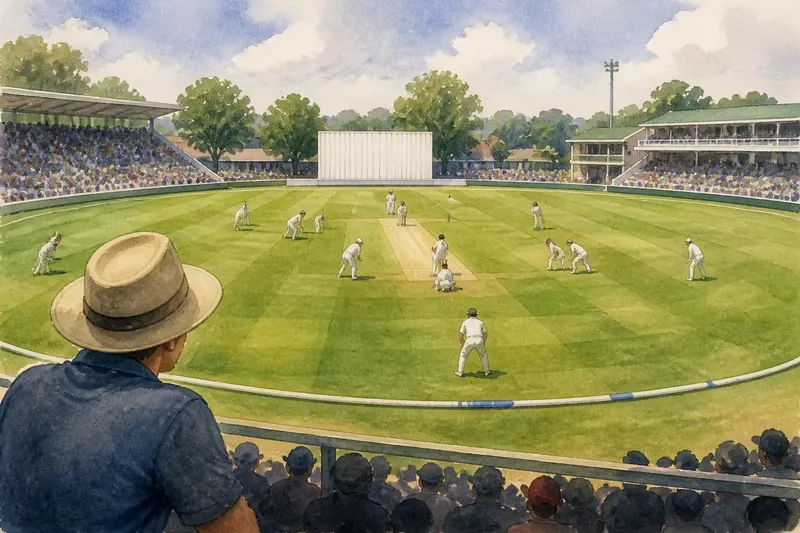
Reading a cricket ground from the boundary starts with a useful question: where is the next important action likely to happen? From the stands, the pitch, boundary rope and fielders can seem like separate features. Notice how they relate, and the ground becomes a map of the match rather than a large lawn with occasional interruptions.
Use a few landmarks before trying to remember every rule or player’s name. They help you follow where the ball is bowled, why a fielder has moved, and what a change in field position may suggest.
Find the pitch and its two ends
The pitch is the prepared rectangular strip at the center of the field. It is where the bowler delivers the ball and the batter faces it. Two sets of wooden stumps stand at opposite ends, with creases marked near each set. On television, the pitch may look like a narrow strip of earth; in person, the surrounding grass makes its central position easier to see.
Choose one end as your starting landmark, then identify the other. A bowler runs in from one end and delivers toward the batter at the opposite end. After an over, the bowling direction switches: the next bowler operates from the other end. The batters’ positions depend on the play. For example, a completed run exchanges their ends; other outcomes, such as a boundary or the end of an over, can affect who faces next. So do not assume the batters simply change ends after every over.
For orientation, pick a fixed feature behind each end: a sight screen, stand, scoreboard or distinctive section of seating. A sight screen gives the batter a clear background when facing the bowler, so it can be a particularly useful marker. Ground staff may call ends by names such as “north end,” but the practical point is to connect each end with something you can see.
Separate the pitch from the wider field
The pitch is only the center of the playing area. The wider field is where fielders spread out and the ball travels after it is struck. A batter can score by running between the wickets or by hitting the ball into the field and running. If the ball reaches the boundary, the scoring result depends on whether it bounced first or crossed without touching the ground.
The rope or painted boundary marks the edge of the field of play. Its shape is not necessarily a circle, and its distance from the pitch can vary around the ground. Stands, advertising boards, open grass and temporary structures may make one section look more enclosed than another. The marked boundary is the relevant reference during play.
Look for boundary markers before play gets busy. They may be a rope, a painted line or markers placed along the edge. The competition and ground setup determine the exact arrangements. If you are unsure, use the boundary line shown on the field rather than a nearby fence or the edge of the seating.
Trace the fielders by position, not by name
Fielders are placed around the pitch to stop runs, catch the ball or pressure batters into a risky choice. Their positions have names, but broad location words are enough to begin: behind the batter, in front, near the pitch or farther out toward the boundary. The bowler, wicketkeeper and fielders close to the bat are usually easiest to identify.
For a quick map, divide the field into zones: in front of the batter, behind, to the left and right, and deep near the boundary. A fielder close to the bat can react quickly to a short shot or deflection. A fielder farther out may be guarding a likely scoring area or covering a hit that travels a long way.
Cricket position names can sound like a compass invented by people who were not given a compass. “Off side” and “leg side” are defined relative to the batter’s stance, not as fixed halves of the ground. For a right-handed batter, the off side is generally in front of the body as the batter faces the bowler; the leg side is behind. For a left-handed batter, those relationships reverse. If the batter changes, the labels change with them.
Watch the field change after the ball is bowled
Field settings are not decoration. The captain and bowler use them to shape the batter’s options. A close group may suggest pressure around the wicket, while several fielders spread toward the boundary may be guarding against a powerful hit. These are clues, not promises: the batter can choose another shot, and the bowler can deliver another kind of ball.
Notice whether the same areas stay protected from delivery to delivery. If a fielder shifts after the batter repeatedly hits toward one part of the ground, the captain may be responding to that pattern. If a player moves from the inner ring to the boundary, or back again, the side may be changing its balance between stopping easy runs and protecting against a larger hit.
Some fielding limits depend on the format and stage of the innings. They can restrict how many fielders may stand outside a marked inner area at a given time. The painted circle, where present, is not the boundary; it is an internal fielding marker. Use it to notice where players are stationed, but do not assume the same restriction applies throughout every match.
Use the creases to follow the batters’ movement
The creases around each set of stumps help define where the batter may stand and what counts as being safely in. The line nearest the bowler is the bowling crease; the batter’s popping crease is marked in front of it. The wicketkeeper and close fielders can make these markings hard to see from a distant seat, so focus on the general area rather than trying to judge a narrow line from the stands.
When the ball is in play, the two batters can run between the wickets. They exchange ends when they complete a run, and they may turn back if they judge another run unsafe. Watch where each batter starts and where each finishes. The result of the play, including whether a run is completed or the over ends, helps determine who faces the next delivery and which end the next bowler uses.
Say you arrive while a right-handed batter is on strike at the far end. You choose the sight screen behind that end as your landmark, then follow the bowler’s run-up and the batters’ movement. Imagine they complete one run and settle at opposite ends; the batter who reached the bowler’s end is positioned to face the next delivery, unless another part of the play changes that outcome. You can follow the movement without relying on the scoreboard, while keeping the result of the ball in view.
Read the surface and surroundings carefully
The pitch may look lighter or more worn than the grass around it. You might also see prepared strips beside the one in use. Their presence does not by itself tell you how the active pitch will behave. Groundskeepers prepare surfaces for matches, and conditions can change with weather, wear and the way play develops.
Look at the outfield as well. A smooth, closely cut area can let the ball travel differently from a patch with longer grass or uneven ground, but a spectator’s view is not enough to judge its speed firmly. Make a simple comparison instead: note where the ball slows, skips or reaches the boundary cleanly, then see whether the pattern recurs.
Also notice the sight screens, drainage covers and any areas roped off from play. These are part of the ground’s working arrangement. Covers may be brought on when rain threatens or the surface needs protection. Procedures depend on the venue and match rules, so follow announcements from officials rather than treating a cover as a signal that play will resume at a particular time.
What should you look for during a first visit?
Where is the pitch?
Find the central strip and its two sets of stumps. Use a stand, sight screen or scoreboard behind each end as a fixed reference so the direction of play remains clear.
How can you tell which side is the off side?
Start with the batter’s stance. The off side is generally in front of the batter, while the leg side is behind; those labels reverse when a left-handed batter faces instead of a right-handed one.
What does a fielder near the boundary tell you?
It shows that the captain has placed someone in a deep area, often to cover a scoring zone or stop a hit reaching the edge. It does not tell you what the next delivery will be, so compare the position with the bowler’s line and the batter’s recent choices.
Is the inner fielding circle the boundary?
No. The circle is an internal marker used for fielding arrangements in some formats or phases of play. The boundary is the marked outer edge of the field, and its appearance may differ around the ground.
Let the ground answer one question at a time
On a first visit, keep the task small. Find the pitch, connect each end to a visible landmark and identify the boundary. Then follow one fielder or one batter for a few deliveries. This is more useful than trying to learn every position name while the bowler is already halfway through the run-up.
When the field changes, ask which area gained protection and which lost it. When the batters run, track where they finish and note the result of the play. When the ball heads toward the rope, follow its path rather than the crowd’s reaction. These checks make reading a cricket ground from the boundary a practical way to follow shifts in the match, even before the finer points of tactics feel familiar.
Bring binoculars if you want to inspect distant fielders; they are less useful for tracking a fast delivery than for locating a player between balls. A paper scorecard or the venue’s official scoring display can help with batter names and the over, while the ground itself remains the best guide to where play is happening. Keep your attention on one landmark at a time, and the field will stop looking like a collection of unrelated patches.