From Leather Panels to Modern Footballs
From leather panels to modern footballs, learn how materials, construction, and match-ball rules shaped a more consistent playing object.
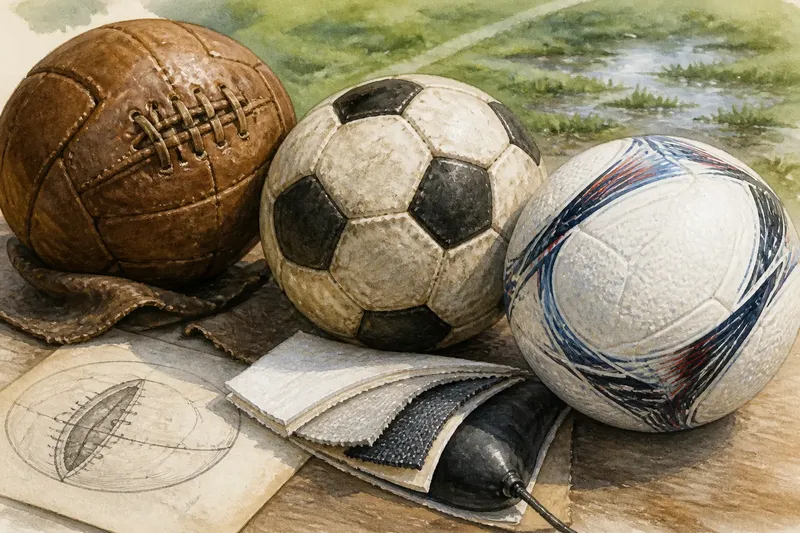
How did association football get from a stitched leather shell to the ball used today? The history of football construction is not a neat sequence of dated breakthroughs; it is a gradual shift in materials, workmanship, and shared rules, with details varying by maker and period.
A match ball must hold air, withstand repeated contact, and behave consistently enough for players to judge its movement. Changes to the bladder, casing, panels, and closure addressed those demands, though no design removed every tradeoff.
Early footballs relied on leather casings
Many early association footballs used an inflatable bladder enclosed by a leather casing. The bladder held the air. The casing protected it and helped give the ball its shape. A lace or similar closure allowed the bladder to be inserted and the casing tightened after inflation.
Leather was a practical material, but it could absorb water and change in feel as it aged. Hand-sewn construction also allowed variation in panel shape, stitching, and how closely the casing fitted around the bladder. The exact experience depended on the ball and its condition, so there was no single, uniform early design.
Shape and inflation affected how a ball responded to a kick. An uneven casing or poorly inflated bladder could make it less predictable. The round, consistent ball players expect today was an aim that depended on both materials and careful construction.
The lace left a raised seam
The lace closed the opening used to insert and inflate the bladder. It served a practical purpose, but left a raised area on the surface. Players could feel that seam when striking or heading the ball.
Rain could also change a leather ball’s feel. A casing that absorbed water might become heavier, though the extent depended on its leather, construction, and playing conditions. Imagine a match on a damp field with a leather ball that has taken on water: players might find it heavier than the dry ball they handled before play. That invented situation illustrates a possible effect, not a report of a specific match.
Bladders and panel layouts developed in varied ways
Improvements in rubber bladder construction helped makers produce a more dependable air-holding core. This did not make every ball identical, but a more stable bladder gave manufacturers a firmer basis for shaping the outer casing.
Panel layouts also varied as makers sought durable, rounded balls. Later designs used different panel shapes and counts, and synthetic materials became common in contemporary footballs. The familiar black-and-white layout associated with televised matches is one recognizable design, not a universal requirement.
Modern balls may use synthetic coverings and bonded or sealed joins instead of a lace closure. Surface texture, panel arrangement, and joining method all contribute to how a ball feels and holds together. A particular appearance does not, by itself, show that a ball meets the rules of a competition.
Football construction and match-ball rules changed together
There is no single transition that explains when footballs became standardized. The process developed alongside organized competition: as teams played under shared rules, specifications for the ball came to define basic properties such as shape, material, circumference, weight, and pressure. The exact requirements depend on the applicable edition of the Laws of the Game and any competition rules.
Today, the International Football Association Board’s Laws of the Game set requirements for the ball used in association football. Competition organizers may also specify approved equipment. These provisions establish a common baseline; they do not require every manufacturer to use the same panel pattern or production method.
For example, imagine a local competition whose rules require an approved match ball. A team brings a ball whose label does not show the required approval. The organizer checks the competition rules and supplies or accepts a ball that meets them; the decision is about eligibility, not whether the first ball looks like a familiar tournament model.
Standardization is therefore better understood as a shared framework than as a single historical invention. Manufacturers can vary designs within the requirements, while organizers and officials apply the rules for their event.
What should a modern ball’s construction tell you?
A modern football combines an outer surface, joined panels, backing layers, and an air-holding bladder. The surface texture can affect grip and touch. The panel layout and joining method affect construction, while the bladder helps the ball retain air and shape.
These choices work together, and models can feel different. A visible pattern identifies a design, not necessarily its approval status. For casual play, distinguish among match balls, training balls, and balls intended for particular surfaces or age groups. Choose according to where and how the ball will be used, and check any applicable competition rules before a match.
What do readers ask about football construction?
Are modern footballs still made of leather?
Many contemporary match balls use synthetic outer materials rather than traditional leather. Models still differ in construction and feel, so check the product information if the surface material matters to your choice.
Why do footballs have different panel patterns?
Panel patterns are design and construction choices, not a universal rule for the ball’s appearance. Different layouts can be used if the ball meets the requirements that apply to its intended competition.
Does a match ball need a particular approval?
That depends on the competition’s rules. Check the organizer’s requirements and the ball’s labeling rather than assuming a familiar design is approved.
Why does inflation matter?
Inflation affects firmness, shape, and response to contact. Follow the pressure guidance printed on the ball or provided by its manufacturer.
Shared rules give the ball its common meaning
Football construction has not moved in a simple line from crude to perfect. Leather casings, improved bladders, synthetic coverings, and revised panel designs reflect changing efforts to make a durable, playable sphere. The rules add a shared definition of the match ball, while leaving room for differences in design.
That distinction is useful when buying or selecting a ball: appearance and construction tell you something about the object, but the competition’s current requirements decide whether it is suitable for a particular match.